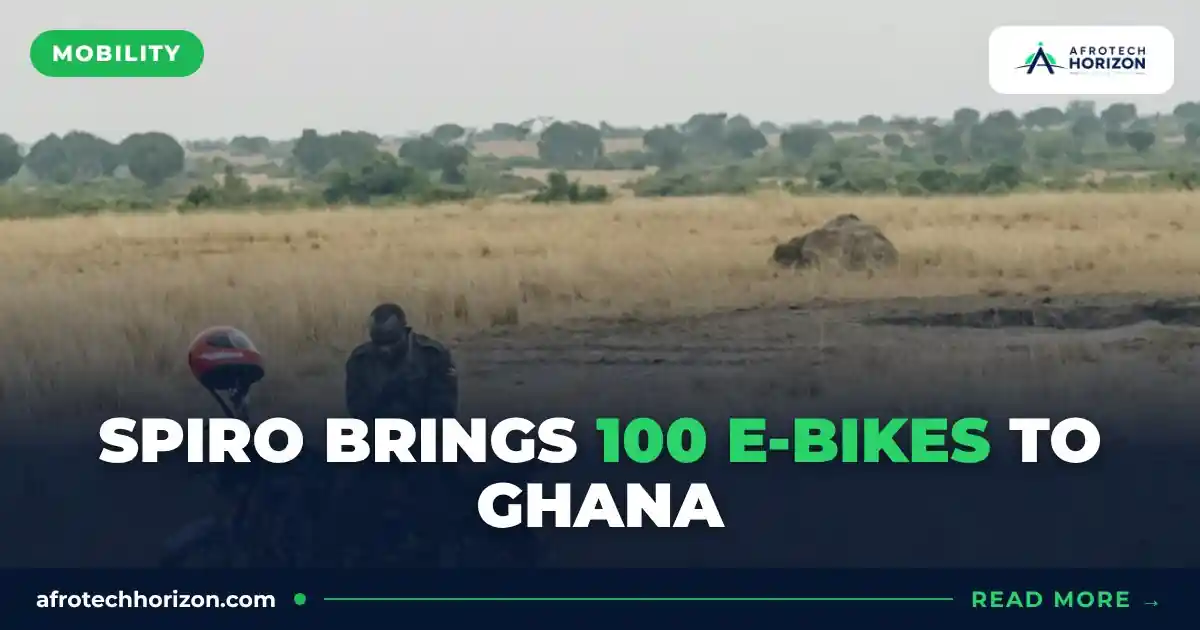
Spiro has put its first 100 electric motorcycles on the road in Ghana, along with a battery-swapping network in Greater Accra. The Spiro Ghana launch, announced on 20 October 2026, brings the company's Ekon 450 M1 V3 bikes to commercial riders and delivery fleets, the people who rack up the most kilometres and feel petrol price rises first.
The rollout is small for now. But it makes Ghana Spiro's eighth market and comes weeks after Ghana's Energy Commission sent rules for EV charging and battery swapping to Parliament. Here is what riders, fleet owners and investors should know.
What the Spiro Ghana launch includes
- Bikes: 100 Ekon 450 M1 V3 electric motorcycles, according to Autocar Professional and Techpoint Africa.
- Swapping: riders swap a flat battery for a charged one at a station, which Spiro says takes about two minutes. That avoids waiting hours for a charge.
- Target users: okada-style commercial riders and delivery businesses in Greater Accra.
- Savings claim: up to $2 a day compared with a petrol motorcycle, Spiro says.
"Ghana represents a major opportunity for electric mobility," Kaushik Burman, Spiro's CEO for mobility, told Autocar Professional, pointing to the country's fast-growing two-wheeler market and demand from delivery fleets.
Spiro has not published the price of the bikes, the cost of a swap, or how many swap stations are open in Accra. Those three numbers will decide whether the $2 saving holds up for a typical rider. As Techpoint notes, real savings depend on distance travelled, petrol prices and swap fees.
Why battery swapping suits commercial riders
For a rider who earns per trip, time off the road is lost income. Plug-in charging can take hours. Swapping turns refuelling into a quick stop, much like buying fuel, which is why Spiro, Ampersand in Rwanda and other operators across the continent have built their models around it.
Earlier this month, Spiro managing director Maxwell Dodd told MyJoyOnline that the company would assemble motorcycles locally in Ghana rather than import finished bikes. He said the plan also includes energy hubs, after-sales service, spare parts and technician training. "Electric mobility is not simply about transportation," he said. Spiro has not given a date for local assembly to start.
The cost question
Spiro told MyJoyOnline its bikes could cut commercial riders' operating costs by as much as 40%. The open questions are the same ones raised in every market Spiro enters:
- What does the bike cost upfront, and is there a lease-to-own option?
- Who owns the battery, and who pays when it wears out?
- How dense will the swap network be outside central Accra?
- How reliable is grid power at the stations?
How big Spiro is now
Spiro says it now runs more than 156,000 electric motorcycles and over 2,500 battery-swapping stations across seven African markets, according to its statement to Autocar Professional on 20 October. In early October the company gave MyJoyOnline a figure of more than 146,000 bikes and 54 million recorded swaps, which suggests it added around 10,000 bikes in a few weeks.
The expansion is backed by debt. In February 2026 Spiro announced $50 million in financing from Afreximbank, Nithio and the Africa Go Green Fund. Nithio has been active across African clean-energy finance this year; it also joined the extended Series B3 of mobility fintech MAX, which we covered in our report on MAX's $29 million round.
Spiro aims to be in 20 African markets. Ethiopia, Malawi, Mali and the Democratic Republic of Congo are on its list of planned destinations, Techpoint reports. Spiro also says its operations across Africa could support more than 200,000 direct and indirect jobs within three years, though it has not broken that figure down by country.
Ghana's rules are still being written
The timing matters. On 22 September 2026, Ghana's Energy Commission said regulations covering EV charging stations and battery-swapping systems had been laid before Parliament. According to Techpoint, the framework is meant to set safety standards, licensing requirements and oversight for operators.
That puts Spiro in an unusual position: launching a swap network while the licensing regime it will fall under is still before lawmakers. Clear rules should help in the long run, because fleet financiers and insurers want to know what standards batteries and stations must meet. In the short term, the final wording could affect where stations can be built and what they cost to run.
What it means for Ghana's tech and mobility scene
- For riders: the pitch is lower daily costs and less exposure to fuel price swings. The test will be swap prices and station coverage.
- For delivery platforms: a fleet on swappable batteries can run longer shifts, and running costs become easier to predict.
- For local suppliers: if local assembly goes ahead, it could create demand for technicians, spare-part dealers and station operators.
- For competitors: other EV players eyeing Ghana now face a well-funded operator that has already started building.
A hundred bikes is a pilot, not a fleet. The number to watch over the next six months is how quickly Spiro adds stations and bikes in Accra, and whether it publishes clear prices for riders.