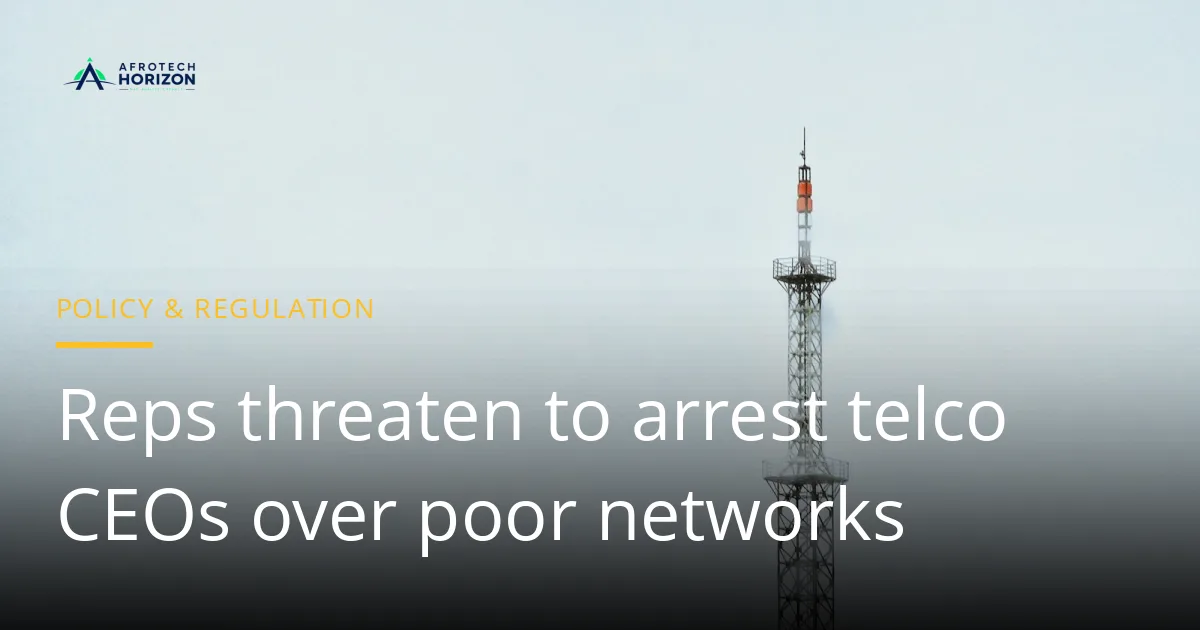
Nigeria's lawmakers have run out of patience with telecom bosses over poor network quality. On Wednesday, 22 October, the House of Representatives' ad hoc committee investigating service quality in the telecom sector ordered the chief executives of MTN, Airtel, Globacom, MAFAB Communications and other operators to appear before it on 28 October. If they do not, the committee says it may issue summons for their arrest, Nairametrics reports.
It is the sharpest step yet in a long-running fight between subscribers, regulators and operators over dropped calls, slow data and failed transfers.
What the committee decided
The resolution followed two motions, moved by Rep. Sunday Umeha (APC, Enugu) and Rep. Afam Ogene (NDC, Anambra). According to Nairametrics, the committee resolved that:
- the Nigerian Communications Commission (NCC) must ensure the CEOs of MTN, Globacom, Airtel, MAFAB and other providers appear on 28 October at the National Assembly Complex;
- operators must submit all relevant documents to the committee on or before the hearing date;
- summons for the arrest of any CEO who fails to appear may be issued.
Committee chairman Rep. Olumide Osoba (APC, Ogun) said the CEOs of MTN, MAFAB and others had not honoured earlier invitations and had sent junior staff instead. He said telecom services had "consistently declined" and pointed out that critical services such as point-of-sale (POS) payments depend on the networks.
Rep. Ibe Osonwa (LP, Arochukwu/Ohafia) criticised operators for earning large revenues in Nigeria while ignoring parliament.
Why poor network quality is now a business problem
For most Nigerians, a bad network used to mean a dropped call. Today it means a failed payment. POS agents, bank apps, ride-hailing, delivery and small online shops all rely on mobile data and USSD. When a network slows in a busy market, sales stop.
That is why the committee framed the issue around POS. A transfer that hangs for minutes creates disputes between agents and customers, and repeated failures push people back to cash.
What the NCC has already said
The regulator has been on record about the causes. Nairametrics notes that:
- in October 2025, the NCC blamed poor service in Lagos, Abuja and other cities on inadequate network capacity in densely populated areas, and called for targeted 5G roll-out and 4G upgrades;
- in April 2026, the NCC began enforcing a compensation framework, under which operators must compensate subscribers in areas where voice, data and SMS quality falls below set standards;
- operators and tower companies invested a combined N2.5 trillion in network infrastructure in 2025, adding or upgrading more than 2,800 sites, according to the NCC.
Subscribers also remember that the NCC approved tariff adjustments of up to 50% in January 2025, on the argument that higher prices would fund network investment. Many users expected service to improve after paying more. That expectation is part of the political pressure now landing on the CEOs.
Can the Reps actually arrest a CEO?
Nigeria's Constitution gives National Assembly committees power to summon people to give evidence and to issue warrants to compel attendance. In practice, arrest threats against executives are usually a lever to secure an appearance, and most CEOs show up once the threat is public. The bigger question is what the hearing achieves.
Operators are likely to argue that quality problems have causes outside their control:
- fibre cuts during road construction, which operators have long complained about;
- theft and vandalism of tower equipment, batteries and diesel;
- unreliable grid power, which forces sites onto expensive generators;
- right-of-way fees and permits that slow new fibre and sites.
Lawmakers, for their part, can push for published quality data by area, faster compensation payouts and firm timelines for capacity upgrades in congested cities.
What subscribers and businesses should watch
- Who turns up on 28 October. A CEO appearance signals the operators are taking the process seriously. Another no-show raises the odds of a formal warrant.
- The documents. If operators file site-level quality data, it could become the most detailed public picture of network performance Nigeria has had.
- Compensation. The NCC framework exists on paper. Businesses that lose sales to outages will want to know how to claim.
- Infrastructure fixes. Cheaper right-of-way and better protection of fibre would do more for quality than a hearing. We looked at why cheaper fibre fees have not yet sparked investment in this analysis.
Nigeria has more than one regulator with a stake here. The NCC sets and enforces quality standards; the National Assembly can investigate and legislate. If both push in the same direction, operators will be under more pressure than at any point since the tariff increase. If the hearing ends in speeches, subscribers will notice that too.
Photo: Rémy Ajenifuja / Unsplash