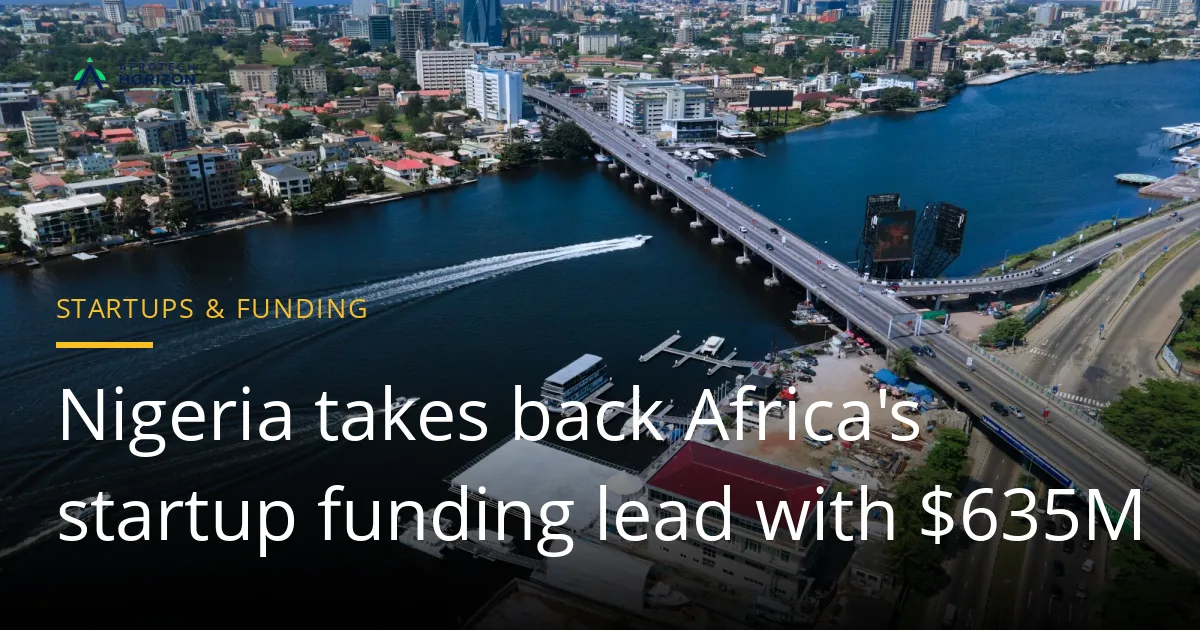
Nigeria startup funding reached $635 million in the first nine months of 2026, putting the country back at the top of Africa's venture table, according to data from the tracker Africa: The Big Deal reported by Nairametrics. That is up from $247 million in the same period of 2025, roughly 2.6 times more, and it already beats Nigeria's full-year 2025 total of $442.8 million.
It is the strongest January-to-September run for Nigerian startups since 2022. But the headline hides a familiar pattern: a handful of large rounds did most of the work.
Where Nigeria startup funding came from
Four deals accounted for $440 million, about 69% of everything Nigerian startups raised this year:
- Moove (mobility financing): $250 million
- Flutterwave (payments): $100 million
- Jumia (e-commerce): $50 million
- Yellow Card (crypto infrastructure): $40 million
Take those four away and the rest of the market raised about $195 million. That is still respectable, and the breadth of activity improved too: 77 Nigerian startups raised at least $100,000 this year, up 10% from 70 a year earlier.
There is also a classification wrinkle. Nairametrics notes that Moove had earlier announced plans to move its operations away from Nigeria, yet its round is counted under Nigeria. How trackers assign headquarters can move these rankings a lot, a point we made in our earlier piece on why African funding totals differ depending on who is counting.
How the Big Four compare
Nigeria's share of country-specific startup funding in Africa (which excludes pan-African ventures) rose to 37%, its highest since 2021. The other large markets moved in different directions:
- Egypt: $445 million, up 10% year on year, though the number of startups raising $100,000 or more fell 29% to 40.
- Kenya: $201 million, down 73%. Part of that drop comes from electric-mobility firm Spiro being reclassified as a pan-African venture. Startups raising $100,000 or more fell 32% to 45.
- South Africa: $182 million, down 58%, with 34 startups crossing the $100,000 mark, down 36%.
Together the four countries took 85% of country-specific funding, up from 83%. Capital is still concentrating rather than spreading across the continent.
A short history of the lead
Nigeria lost the top spot after 2022. In 2023 its startups raised about $410 million, less than half the 2021 and 2022 levels, while Kenya led with about $800 million. In 2024 Nigeria stayed near $400 million and behind Kenya again. This year's rebound reverses that, at least on the numbers so far.
Logistics overtook fintech
The sector picture changed too. Across Africa, logistics and transport startups raised $780 million in the period, 36% of all funding and a record share. That compares with 7% in 2025 and a previous high of 17% in 2019. Fintech raised $760 million, or 35%.
Two companies explain most of the logistics jump: Spiro ($345 million) and Moove ($250 million) together make up about 76% of the sector's total. Fintech still leads on the number of funded companies, with 80 fintech startups raising at least $100,000.
What this means for founders
For a Nigerian founder, the data offers mixed signals.
- Big cheques are back, for a few. Late-stage companies with revenue and a route to profit, such as Flutterwave and Moove, can raise again.
- Early-stage money is thin. Our earlier report showed Nigerian startup funding fell 97% in September alone, which shows how lumpy monthly flows are when a few deals dominate.
- Asset-heavy models are attracting capital. Vehicle financing and electric mobility pulled more money than payments this year. Investors seem willing to fund businesses that own physical assets they can lend against.
- Macro still matters. A steadier naira and falling inflation help investors price risk. A reversal in either would show up in deal flow quickly.
The fourth quarter
Three months remain, and Q4 is often busy as funds close out their year. If Nigeria keeps its pace, it could finish 2026 with its best year since 2022. If the next large round lands in Cairo or Nairobi instead, the ranking could flip again by December, which is why the more useful figure to watch is the count of startups raising $100,000 or more. That number grew in Nigeria this year while it shrank in Egypt, Kenya and South Africa, and it says more about the health of the ecosystem than any single mega-round.
Is Nigeria's comeback real, or is it four deals in a trench coat? Tell us what you are seeing on the ground.