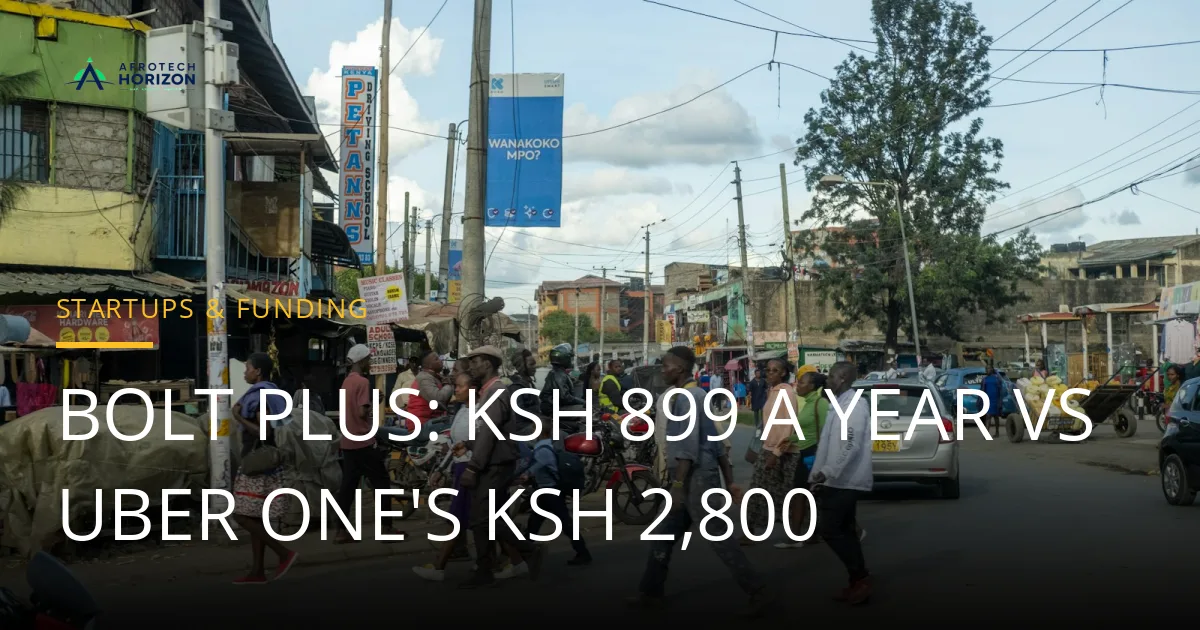
Bolt Plus, the ride-hailing company's new subscription in Kenya, costs KSh 899 a year, or about KSh 75 a month. That is less than a third of what Uber charges for its annual Uber One plan in the same market, and it is the clearest sign yet that Kenya's ride-hailing and delivery apps are now fighting over loyalty rather than single trips.
Bolt launched the plan on 15 October 2026 at an event in Westlands, Nairobi, according to Citizen Digital and The Star. TechCabal described the annual price as Bolt "practically giving away" the subscription. Here is what subscribers get, how it compares with Uber One and Glovo Prime, and what the pricing says about the market.
What Bolt Plus includes
The monthly price is KSh 280. The annual option is KSh 899. New subscribers get the first month free, then an introductory rate of KSh 119 a month for six months before the standard price applies, Streamline Feed and TechTrendsKE reported.
The benefits listed in those reports are:
- Cashback on rides: 10% on Comfort, Premium and Business rides, and 5% on Bolt Basic. The money goes into the user's Bolt Balance and can only be spent on Bolt services.
- Free delivery on eligible orders from selected restaurants and shops on Bolt Food. Ivy Njeri Maingi, Bolt Food's general manager in Kenya, said the saving can reach KSh 200 per qualifying order.
- Priority driver matching, including at peak times and in bad weather.
- Three free cancellations a month without penalty fees.
Reports did not mention a cap on cashback or a monthly limit on free deliveries.
Bolt Plus vs Uber One vs Glovo Prime
Kenyan users now have three paid memberships to choose from. Based on figures reported by TechTrendsKE and Streamline Feed:
- Bolt Plus: KSh 280 a month or KSh 899 a year. 10% or 5% ride cashback, free delivery on eligible orders.
- Uber One (in Kenya since March 2025): KSh 280 a month or KSh 2,800 a year. 10% cashback on Comfort and UberXL, 5% on UberX, and waived delivery and service fees on Uber Eats orders above KSh 600.
- Glovo Prime: KSh 400 a month for free delivery from participating restaurants, grocers and pharmacies. Glovo says members save about KSh 150 per order on average.
The monthly prices for Bolt and Uber are identical. The difference is all in the annual plan. Twelve monthly Bolt payments add up to KSh 3,360, so the yearly option saves KSh 2,461. Uber's yearly option saves KSh 560 against paying monthly. Spread over twelve months, Bolt's annual plan works out at roughly KSh 75 a month and Uber's at roughly KSh 233.
Why Bolt is pricing so low
A subscription priced this low is not mainly a revenue line. It is a way to make Bolt the default app on a user's phone. Once someone has paid for a year, they have a reason to open Bolt first for every ride and every food order, and the cashback can only be spent inside Bolt.
That matters in a market where switching costs are close to zero. Many Kenyan riders keep several apps and compare prices before each trip. A paid membership changes that habit.
The plan also pushes users towards Bolt's higher-priced ride categories, where the 10% cashback applies, and towards Bolt Food, where it competes directly with Glovo. Glovo Kenya managing director Caroline Mutuku has said the company works with more than 6,000 merchants in Kenya, around 80% of them small and medium businesses, across 12 towns and cities, TechTrendsKE reported.
Who pays for the discounts
Bolt has said the promotions will not cut driver and courier earnings, and that the platform absorbs the cost, according to Streamline Feed. Drivers will watch that closely. Kenya's ride-hailing sector has spent much of 2026 in a dispute over commissions, including an 18% commission ceiling that ended up in court proceedings this year, TechTrendsKE noted.
The market behind the battle
The size of Kenya's digital consumer base explains why the platforms are spending on loyalty. The Communications Authority of Kenya counted 84.1 million active mobile subscriptions in the third quarter of its 2025/2026 financial year, and a record 53.4 million mobile money subscriptions, as cited by Streamline Feed. Paying for a digital service every month, the basic habit a subscription relies on, is already common.
Our recent report on Safaricom's Fuliza ya Pochi overdrafts showed the same pattern from the payments side: Kenyan platforms are trying to own more of each customer's everyday spending.
Is Bolt Plus worth it?
For an occasional rider, the maths is simple. At KSh 899 a year, a user who takes premium rides needs to spend about KSh 9,000 a year on them to earn back the fee through 10% cashback alone, before counting any delivery savings. At the full monthly price of KSh 280, Streamline Feed estimated the break-even point at about KSh 2,800 a month in premium rides.
Three things to check before subscribing:
- Which ride type you usually take, since Basic rides earn only 5%.
- Whether your usual restaurants carry the free-delivery badge.
- That cashback cannot be withdrawn, only spent on Bolt.
The next question is how Uber and Glovo respond. A price cut on Uber One's annual plan would confirm that Kenya's app war has moved from per-trip discounts to memberships.