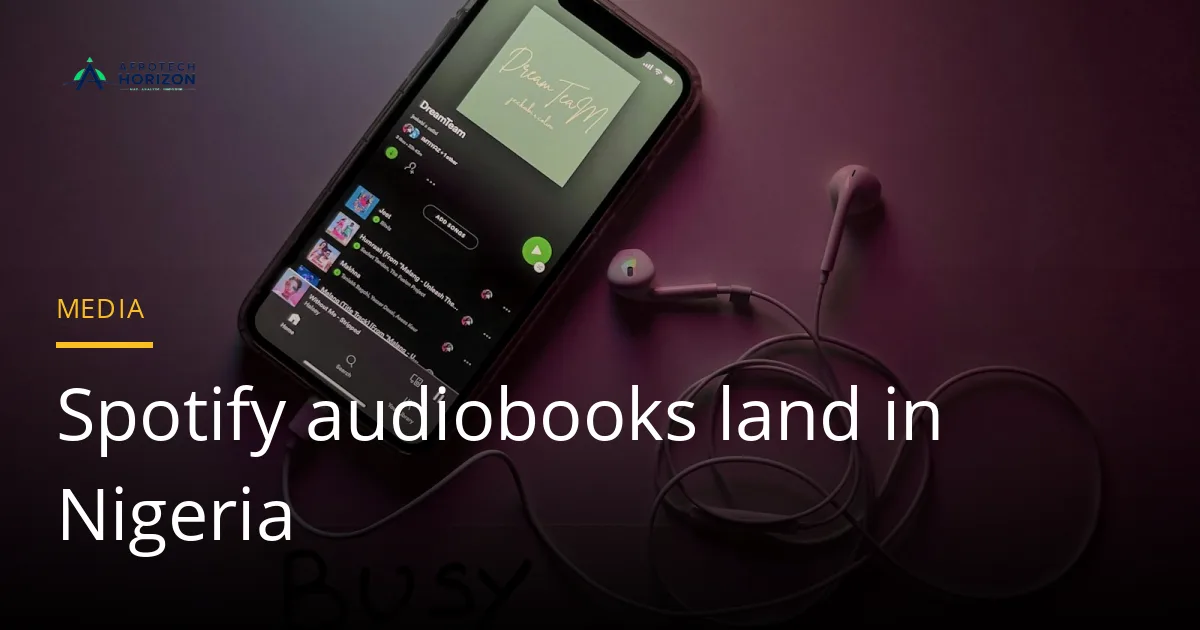
Spotify audiobooks are now available in Nigeria. The streaming company switched on the service on 14 October, adding spoken-word books to the music and podcasts Nigerians already stream in the app, Techpoint Africa reports. The headline price is ₦2,300 a month for 15 hours of listening, roughly $1.73 at the exchange rate Techpoint used.
The launch is part of a wider rollout. Spotify says audiobooks will reach more than 180 markets by the end of 2026, covering over 750 million people. For Nigeria, the more interesting question is not the price but the catalogue, and whether Nigerian writers and publishers will use the platform to reach listeners at home.
How Spotify audiobooks pricing works in Nigeria
There are three ways to pay, according to Techpoint Africa:
- Audiobooks+ add-on: ₦2,300 a month. Available to both Free and Premium users. It includes 15 hours of listening per billing cycle.
- Top-ups: ₦2,700 for 10 more hours. For listeners who use up their monthly allowance early.
- Buy a single book. Users can purchase individual titles to keep, without any monthly allowance.
Two details matter for heavy listeners. First, "only time spent actively listening counts towards the allowance," so leaving a book paused does not burn hours. Second, the allowance resets at the start of each billing cycle; unused hours do not roll over.
Fifteen hours is enough for one or two average-length audiobooks a month. A listener who finishes a long novel early and tops up once would pay ₦5,000 in a month. That is still cheaper than most imported print books in Lagos, but it adds up for students and young professionals, who are the likeliest early users.
Features that suit Nigerian listeners
Spotify is bringing the same features it offers in other markets:
- Offline downloads. Useful where mobile data is expensive or patchy. Download on Wi-Fi, listen on the bus.
- Page Match. Scan a physical book's ISBN barcode and the app jumps to the matching point in the audio version, using page numbers. Spotify says it supports more than 30 languages.
- Cross-device sync across more than 2,000 supported devices, from phones to cars and speakers.
- Sleep timer and a dedicated audiobooks section with recommendations based on what you already listen to.
Offline listening is the feature most likely to drive adoption. Data costs shape how Nigerians use streaming apps, and a book downloaded once can be played many times without spending more data.
The opening for Nigerian authors
The part of this launch that could matter most to Nigeria's creative economy is Spotify for Authors. Through it, local publishers and self-published writers can upload audiobooks and see data on who is listening. Spotify says its audiobook deals are non-exclusive, so authors can sell the same titles on other platforms too.
That is a real distribution channel for a market where print runs are small and bookshops are concentrated in a few cities. A Nigerian author who records an audiobook could, in principle, reach listeners in Kano, Accra and London through the same app.
There are open questions. Techpoint notes that Spotify has not said how big the Nigerian catalogue is at launch or how many titles come from local publishers. Recording a good audiobook also costs money: studio time, a narrator, editing. Without clarity on how authors are paid per listen, many will wait to see whether the numbers work.
What Spotify's global numbers suggest
Spotify first offered audiobooks to Premium subscribers in 2023. It says monthly audiobook listeners grew nearly 40% over the past year and listening hours rose more than 30%. Audiobooks+, launched just over a year ago, has more than one million subscribers worldwide.
Those figures show demand exists in markets where the service is mature. Nigeria will test whether the same behaviour shows up when the price is set in naira and the catalogue is mostly foreign.
Why this matters for African digital services
Global platforms are pricing more products locally in African markets, and Nigerian users increasingly pay for software in naira through cards and bank apps. That brings convenience, but it also brings tax and currency exposure. In Ghana, banks now add 20% VAT and levies to foreign digital services, as we reported in Ghana Digital Services Tax: Banks Now Add 20% to Netflix, ChatGPT and Cloud Bills. If Nigeria moves the same way, naira prices for services like Audiobooks+ could change.
For local audio startups and publishers, Spotify's arrival is both a threat and an opportunity. It raises listener expectations for app quality and catalogue size. It also gives local creators a way onto a platform millions of Nigerians already open every day.
Should you sign up?
- If you already listen to podcasts on Spotify and finish one or two books a month, ₦2,300 for 15 hours is a fair trial.
- If you mainly want Nigerian or African titles, browse the catalogue before you pay; the local selection is not yet clear.
- If you are an author, look at Spotify for Authors' terms and listener data before investing in a recording.
Spotify audiobooks give Nigerian listeners a cheap, legal way to try audio books. Whether the service grows will depend on how many Nigerian voices end up in the catalogue.