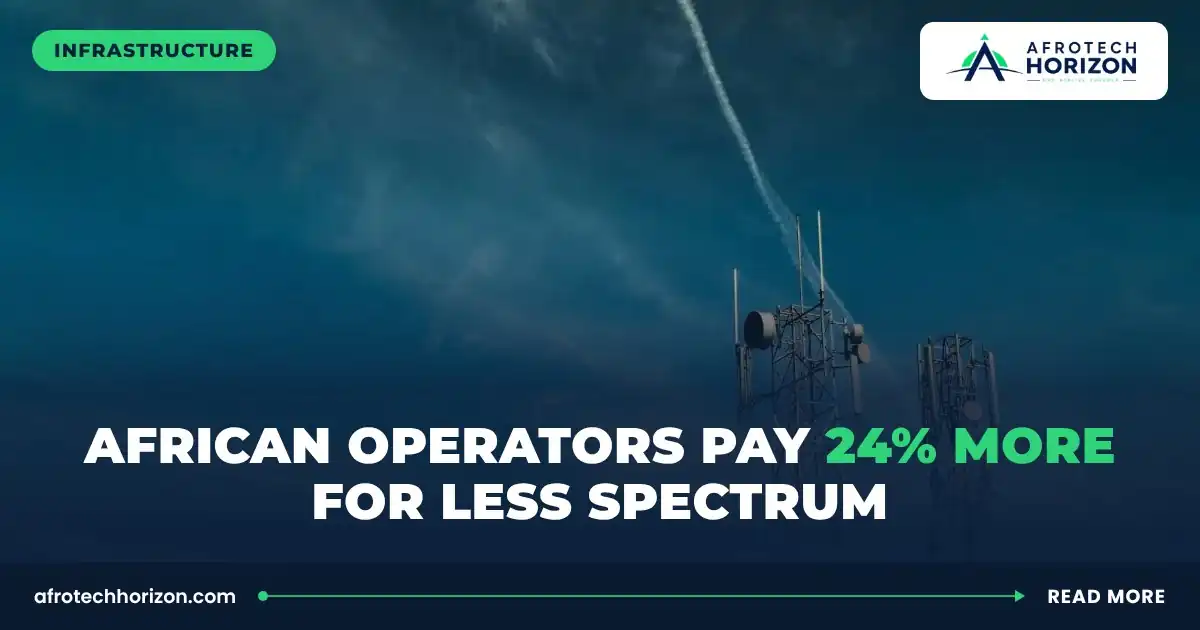
Spectrum costs in Africa are higher than almost anywhere else once you account for how much airwave capacity operators actually get. A new GSMA Intelligence report, Spectrum Policy in Africa, published on 15 October, finds that African mobile operators hold less spectrum than their peers and pay 24% more for each unit of it relative to revenue.
The report, written by GSMA Intelligence economists Francisco Amaya and Kalvin Bahia, lands as more than 200 African mobile licences approach renewal. How governments price those renewals will shape 4G and 5G rollout for the next decade.
What the GSMA found on spectrum costs in Africa
At the end of 2025, African operators held about 570MHz of mobile spectrum below 7GHz on average. Operators in the rest of the world held about 750MHz. Europe averages 945MHz per operator and North America 1,136MHz.
The gap is wider in the bands that carry fast data. Only 24 of Africa's 54 countries have assigned any 3.5GHz spectrum, the main 5G band, and only five have assigned 300MHz or more. About a third of low-band spectrum, the frequencies that cover rural areas cheaply, is still unassigned.
On price, the report uses a cost-to-revenue ratio adjusted for 100MHz of spectrum:
- African operators spend 0.82% of revenue per 100MHz, against 0.66% elsewhere.
- That makes the per-unit burden 24% higher in Africa.
- Total spectrum spending as a share of revenue is actually lower in Africa (6% against 7%), because operators have so little spectrum to pay for.
In other words, African operators are not spending more in total. They are getting less for what they spend.
Revenue has fallen while prices stayed put
The report points to a squeeze on the revenue side. Average revenue per user in Africa fell by about 49% in real terms between 2015 and 2025. Revenue per gigabyte dropped 92%, and revenue per MHz per connection fell more than 69%. Operators have kept investing at around 20% of revenue, the GSMA says, but a shrinking revenue base limits how much that buys.
The countries paying the most
The GSMA lists 14 markets with above-average spectrum cost burdens: Benin, Botswana, Burkina Faso, Cameroon, Egypt, Eswatini, Gabon, Mozambique, Niger, the Republic of the Congo, Senegal, Sudan, Tunisia and Zambia.
Egypt is the starkest case. Spectrum costs there have approached or exceeded 20% of operator revenue. Operators paid a combined $600 million for 5G licences that, according to the report, came with no new spectrum. Currency depreciation has made those costs heavier.
Licence conditions add to the bill. In Benin, direct spectrum fees are about 7% of operator revenue, but the GSMA estimates that coverage and quality-of-service obligations add a further 66% on top of that. In Rwanda, operators pay less than 1% of revenue in direct fees, a figure also reported by The New Times, but total costs reach 14% once obligations are counted. In Uganda the figures are 2% and 8%.
Short licences and missing roadmaps
Only nine of Africa's 54 countries grant licences of 20 years or more across all active licences, and only nine have published a spectrum roadmap. Short terms make long network investments harder to justify. Tanzania's July 2025 auction of 200MHz in the 3.6GHz to 3.8GHz range set reserve prices at a 30% discount to estimated market value, but it used 15-year licences, which the report calls shorter than best practice.
Nigeria gets credit for giving operators more certainty. Early in 2026 it published a Spectrum Roadmap for the Communications Sector covering 2026 to 2030, with planned assignments in the 600MHz, 1.4GHz, upper 6GHz and millimetre-wave bands.
What the GSMA wants governments to change
The report's recommendations focus on pricing and licence terms rather than new money:
- Assign spectrum to whoever will deliver the most social and economic value, instead of maximising state revenue.
- Set low auction reserve prices and avoid annual fees on spectrum already bought at auction.
- Base renewal prices on forward-looking value, not on historical prices.
- Grant licences of at least 20 years, presume renewal, and allow trading and leasing.
- Make licences technology-neutral so operators can run 4G or 5G in any band.
- Publish long-term roadmaps and allocate the full upper 6GHz band (6.425GHz to 7.125GHz) to mobile.
Rwanda is the report's main evidence that licensing rules matter. Between 2013 and 2022, its 800MHz and 2.6GHz spectrum went exclusively to a single wholesale network. After the country moved to technology- and service-neutral licences in 2022, 4G penetration rose from about 2% of the population to more than 30% within two years, according to the GSMA.
The $120 billion claim
The GSMA estimates that its reform package would add more than $120 billion to African GDP between 2026 and 2035, extend 5G to 170 million more people and 4G to 50 million more, and raise average download speeds by 30% to 50%. These are the industry body's own projections. It also calculates that pricing renewals in line with falling revenue per MHz would cut spectrum costs as a share of revenue by almost 30%, and automatic renewal by more than 50%.
Why it matters for African tech
Coverage is no longer the main gap. By the end of 2025, 4G reached 83% of Africa's population and 5G reached 15%, the report says. Yet only 28% of people used mobile internet on their own device, against 66% in the rest of the world. We looked at that usage gap in our report on why millions of Africans with coverage are still not online.
Spectrum pricing feeds directly into data prices and network quality, which affect every fintech, e-commerce and streaming business that depends on mobile users. Governments face a real trade-off here. As Semafor noted, auctions are a significant source of state revenue, and finance ministries will not give that up easily. TechCentral also noted that the growth and GDP figures are the GSMA's own projections, and the GSMA represents the operators that stand to gain.
The test will come with the renewal wave. More than 200 licences worth over $10 billion fall due by 2035. Whether regulators treat them as a cash event or as an investment tool will decide how quickly the next 170 million Africans get 5G.