

Breaking the Monopoly of the "Big Four"
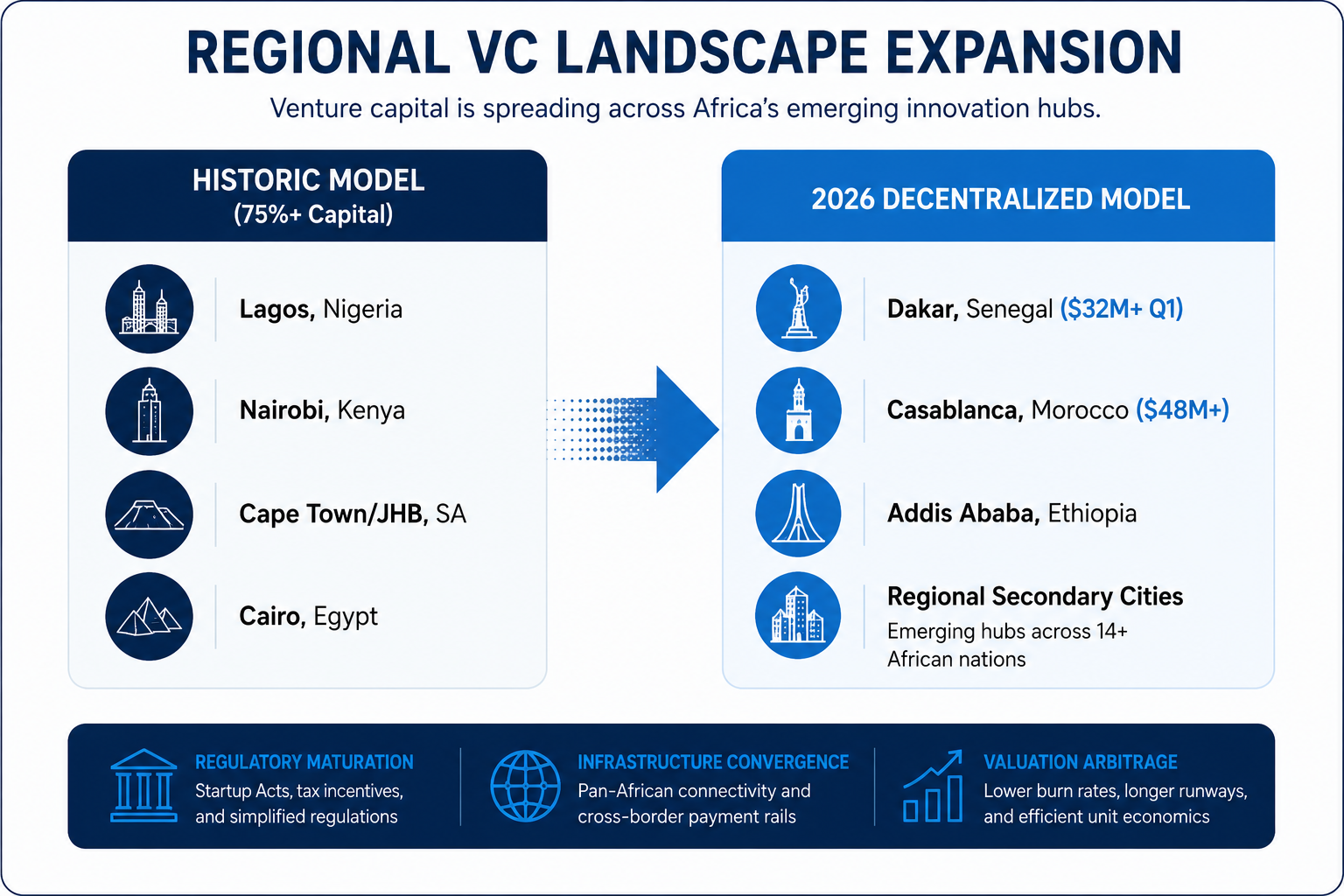
The Rise of Francophone and Horn of Africa Ecosystems
In Senegal, startup investment topped $32 million in a single quarter, backed by progressive regulatory initiatives like the Senegalese Startup Act and a rapidly growing talent pool in Dakar. In Ethiopia, economic liberalization, mobile money expansion, and telecom competition have turned Addis Ababa into a high-potential market for fintech and logistics enablers.
Morocco has simultaneously emerged as North Africa's bridge to both West Africa and European capital. With major venture raises by local category leaders like ORA Technologies (super-app ecosystem) and AgriEdge (precision farming), Casablanca is proving that Francophone markets can produce enterprise software that scales across borders.
Why Investors Are Spreading Their Bets
Several macro drivers are forcing this geographic rebalancing:
Regulatory Maturation: Countries across West and East Africa are enacting dedicated Startup Acts that offer tax incentives, streamlined IP registration, and simplified cross-border currency transfers.
Infrastructure Convergence: The rapid deployment of pan-African subsea fiber optic cables and cross-border payment rails means a software platform built in Dakar or Tunis can serve enterprise clients in Abidjan or Douala with zero operational friction.
Valuation Arbitrage: Startups operating outside hyper-competitive hubs often operate with leaner burn rates, longer runway potential, and lower customer acquisition overhead, yielding healthier unit economics for early-stage investors.
The part that is not about geography
Innovation has never been geographically biased; capital allocation was. When venture capital spreads beyond three or four major metropolitan centers, tech development stops being an exclusive playground for urban elites. It means young developers in Francophone West Africa, the Horn of Africa, and Central Africa can build software that solves immediate problems in their own backyards without leaving their communities behind.
Industry Takeaway: Investors are diversifying geographically to discover untapped tech talent, lower operating overheads, and favorable regulatory environments across expanding regional hubs.
Source & Further Reading: Empower Africa - African Startups Raise $705 Million in Q1 2026 as Investment Expands