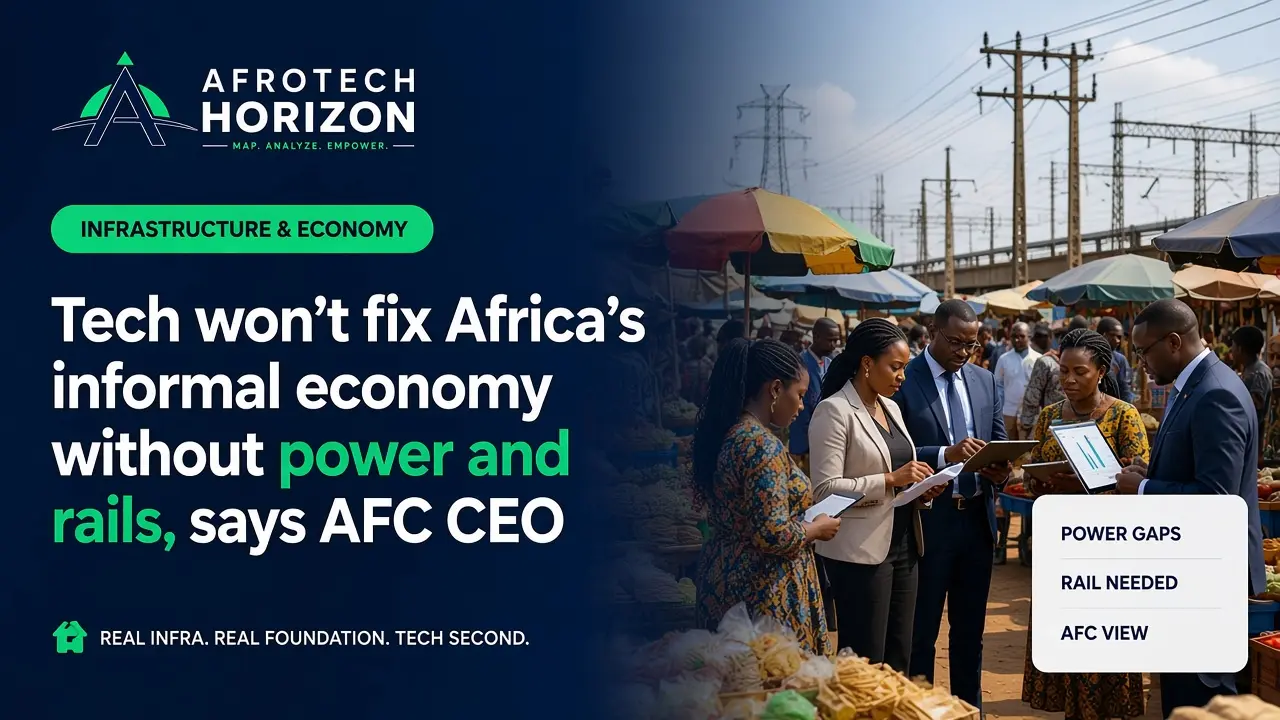
Bringing informal businesses online and building mobile applications will deliver limited economic impact across Africa without massive investments in physical infrastructure. Speaking at the Africa Financial Industry Summit (AFIS) in Luanda, Angola, Africa Finance Corporation (AFC) chief executive officer Samaila Zubairu argued that digital software platforms alone cannot fix the structural challenges facing the informal sector if basic utilities and transport networks remain missing.
Overcoming Physical Bottlenecks in the Informal Sector While fintech software and mobile platforms have expanded digital access, physical supply chain deficiencies continue to constrain small business productivity and intra-regional trade.
Power and Storage Shortages: Informal merchants and agricultural producers struggle to scale because of unreliable electricity grids and a lack of cold storage facilities to preserve inventory.
Transport Deficits: The absence of efficient rail networks and freight corridors inflates logstical expenses, preventing local producers from moving goods across borders efficiently.
Limits of Software Innovations: Digital payment applications and online storefronts cannot replace essential physical assets required for industrial manufacturing and regional distribution.
Capitalising on Infrastructure Corridors for Value Addition Zubairu highlighted strategic infrastructure projects, such as the Lobito Corridor connecting Angola, the Democratic Republic of Congo, and Zambia, as transformative models for continental growth.
Developing Economic Corridors: Expanding railway and energy infrastructure to facilitate raw mineral processing and agricultural distribution within the continent.
Local Processing and Industrialisation: Moving away from raw material export models by establishing processing hubs powered by stable energy grids.
Targeted Capital Allocation: Directing institutional financing into core transport, power, and logistical infrastructure rather than focusing solely on digital interface layers.
To explore further technical analysis on industrial infrastructure, energy development, and economic policy across Africa, visit AfroTech Horizon.
Building Hard Infrastructure for Long-Term Growth Samaila Zubairu’s remarks at AFIS serve as a critical reminder for technology builders and policy makers across Africa. While digital innovation streamlines commercial touchpoints, lasting economic transformation relies on constructing reliable power systems, storage infrastructure, and freight transport networks across the continent.