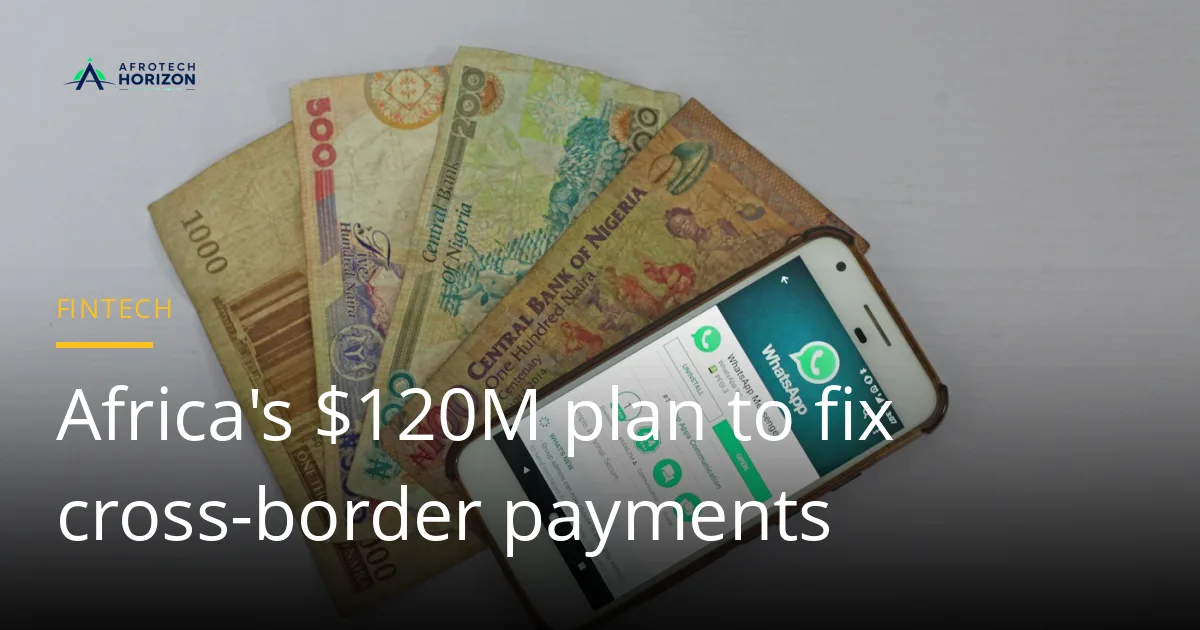
Sending money from Lagos to Nairobi should not cost more, or take longer, than sending it from Lagos to London. Yet it often does. A new feasibility study from the AfricaNenda Foundation says fixing cross-border payments in Africa will take at least $120 million and a legally binding African Union agreement, and that the work could run for ten years.
The study, titled African Regulatory Harmonization Framework for Cross-Border Payment Services, was reported by Business in Cameroon on 27 October 2026. It is less about new technology than about rules: the problem, it argues, is that each country checks payments differently.
Why cross-border payments in Africa stay slow
According to the study, the main friction is regulatory. National rules on customer identity checks (know-your-customer) and anti-money-laundering screening differ from country to country. A payment that clears easily at one end can be held up at the other.
The study also says countries apply the shared standards of the Financial Action Task Force (FATF) inconsistently. In practice, a fintech moving money across five markets may have to build five versions of the same compliance process.
Sabine F. Mensah, deputy chief executive of AfricaNenda, put it simply at a meeting in Nairobi on 5 October: "If the sending requirement and the receiving requirement are harmonized, then it becomes easier to transfer money."
The cost of the current system
- Cross-border payments in Africa were worth about $329 billion in 2025, according to the study.
- That figure could reach $1 trillion by 2035.
- Routing intra-African payments through foreign currencies, usually the dollar or euro, costs an estimated $5 billion a year.
That $5 billion is money paid to banks and intermediaries simply because two African currencies cannot easily meet each other directly.
What the plan asks for
AfricaNenda sets out three conditions, each with a deadline:
- Money. At least $120 million secured by the end of the first year of implementation. It would pay for common standards, technical help to regulators, stronger regulatory institutions and the gradual alignment of national payment rules.
- A binding agreement. The African Union should adopt a binding protocol or convention within two years. Voluntary guidelines, the study implies, have not been enough.
- An oversight body. A continental supervisor set up within 36 months of the study's endorsement, housed in the Association of African Central Banks (AACB) and working with the AU.
The study also argues against building new rails. It recommends using what already exists, naming the Pan-African Payment and Settlement System (PAPSS) and the regional GIMACPAY platform used in Central Africa, rather than launching competing systems.
Which regions go first
Not every bloc is ready. The study grades Africa's regional economic communities like this:
- Ready for the first phase: the West African Economic and Monetary Union (WAEMU) and the East African Community (EAC).
- Conditionally ready: CEMAC, ECOWAS and SADC.
Reforms would roll out over ten years, with each bloc joining once it meets the regulatory and institutional requirements. WAEMU's single currency and central bank give it a head start. The EAC has years of work on regional payment links behind it.
What this means for fintechs
For startups, the prize is lower compliance cost. A company that can run one identity and screening process across a whole region can expand faster and price transfers more cheaply. Payment firms in Nigeria, Kenya and the CFA zones currently carry heavy legal and compliance teams partly because of this fragmentation.
The catch is time. Two years for an AU protocol and three for an oversight body is fast by the standards of continental treaties, and the ten-year rollout means most of today's startups will operate under the current patchwork for a while yet. Founders building cross-border products should keep an eye on which blocs move first, since WAEMU and the EAC look likely to set the template.
Stablecoins have been pitched as a way around these problems, but they hit the same wall when money has to leave the blockchain. We looked at that issue in our report on Raenest's move into stablecoin products.
What happens next
AfricaNenda will publish the fifth edition of its State of Inclusive Instant Payment Systems (SIIPS) in Africa report on 19 November 2026 in Balaclava, Mauritius, during a meeting of policymakers, regulators and payment operators from 18 to 20 November. Mensah said the new edition will focus on the effect of instant payments on people, businesses and economies, with more consumer surveys than before. "In this fifth edition, we are all about impact," she said.
The bigger test is political. Without a binding AU decision and the $120 million behind it, the study stays a study.
Source: Business in Cameroon, 27 October 2026, reporting on AfricaNenda Foundation's feasibility study.