
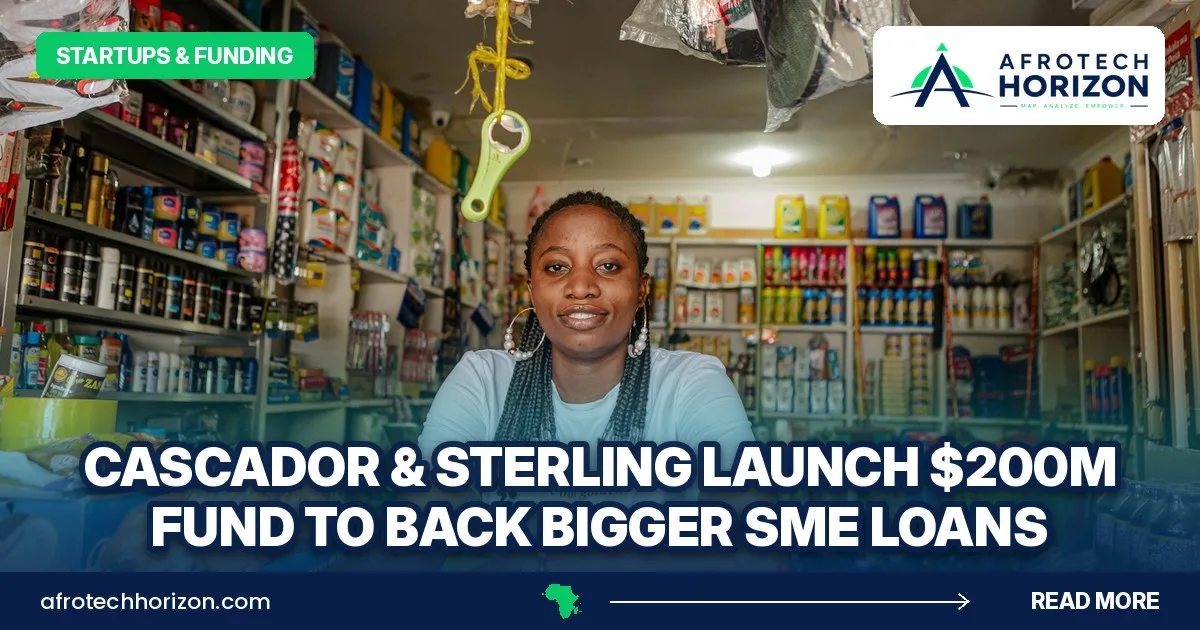
Nigerian small businesses that have outgrown grants but can't meet a bank's collateral demands may soon find bigger loans easier to get. Venture builder Cascador and Sterling Bank announced a $200 million SME credit backstop fund on 14 October. It will cover part of the losses that lenders take on approved loans to these businesses.
The partners say the reserve can support up to $1 billion in outstanding credit. First loans will be in naira, worth about $250,000 each, and the ceiling rises to $1 million per business once the fund is fully capitalised, according to BusinessDay and Techeconomy.
How the SME credit backstop fund works
The fund doesn't lend money itself. Venture funds, studios and other ecosystem partners nominate businesses they already know. The fund checks each one against its own eligibility, guarantee and portfolio-risk rules, using AI-assisted underwriting. If a business passes, the lender gets a defined level of protection against losses on that loan.
The bank still does the lending. It assesses the borrower, approves and pays out the loan, and handles repayments and collections. What changes is how much risk the bank carries, and so how much collateral it needs to ask for. Repayment periods are also meant to follow the borrower's cash flow, rather than the short tenors common in Nigerian SME lending.
The fund runs through two companies. Riverwell Platform Holding Limited is registered in the UK, and Riverwell Platform Services Nigeria handles partner coordination, borrower checks, data and portfolio monitoring. A third, separate company holds the reserve capital. Sterling Bank group executive Obinna Ukachukwu will sit on the Riverwell board.
Built on a two-year pilot
Cascador and Sterling have tested this before. For about two years they ran a smaller catalytic fund in which Cascador nominated and guaranteed borrowers and Sterling lent to them. The new vehicle turns that into a standalone platform that other backers can join. The partners want philanthropic funders, impact investors and development finance institutions to add capital to the guarantee reserve, which would let it cover more loans.
Cascador says the 80 ventures it has backed since 2019 have raised more than $150 million. In 2025 they served over 1.7 million customers and directly employed close to 4,000 people.
Collateral is the problem it targets
Cascador released a white paper, The Multiplier Model, alongside the fund. It notes that 22% of businesses in Sub-Saharan Africa hold a bank loan or line of credit, compared with a global average of 36%. Banks usually want property or other hard assets as security. Many young companies with steady revenue simply don't have them.
That leaves founders choosing between raising more equity, and giving up more of the company, or staying small. Equity has been an unreliable option this year. Nigerian startups raised just $11.3 million in September after a $364 million August that was mostly one deal, as we explained in our breakdown of September's 97% fall. Across the continent, trackers disagree on the totals but agree that money is going to fewer, larger rounds (see our look at the 2026 funding numbers).
"Equity must work with debt and long-term securities to provide builders with the capital they need to build the future," said Iyinoluwa Aboyeji, founding partner at Future Africa, in comments reported by BusinessDay. Cascador CEO Trish Thomas said Nigeria is "rich in entrepreneurial talent and innovation."
What founders should know
You can't apply to the fund directly. A business has to be nominated by a participating ecosystem partner, already have commercial traction and be ready to carry commercial debt. If you're interested, start by asking your investors or studio whether they are part of the nominating network.
Every loan still needs the bank's approval, and the amount of credit that actually reaches SMEs depends on how much more reserve capital the partners raise. Sterling has a stated lending focus on health, education, agriculture, renewable energy and transport. The fund itself hasn't published sector limits.
If it works, investors get a way to support portfolio companies without another equity round, and banks get cover to lend to businesses they would normally turn down. The first thing to watch is how quickly the initial $250,000 loans move from nomination to payout.