The Hidden Cost of Offshore AI
Artificial Intelligence has transitioned from an experimental buzzword into a core requirement for enterprise software. Whether it is an automated credit scoring engine in Nairobi, an emergency medical triage network in Lagos, or a multi-lingual customer service platform in Johannesburg, AI agents are handling millions of daily interactions across the continent.
However, running high-compute AI models on server hubs located in Europe or North America presents massive operational challenges:
High Latency: Routing daily queries across thousands of miles of subsea fiber introduces noticeable delays for time-sensitive applications like fraud detection and autonomous logistics.
Foreign Exchange Risk: Enterprise cloud bills denominated in foreign currencies turn into financial landmines whenever local currencies fluctuate against the US dollar or Euro.
Language and Cultural Bias: Global large language models (LLMs) routinely fail to process regional dialects, indigenous languages, and unique African commercial practices accurately.
Hyperscale Expansion and Sovereign Data Frameworks
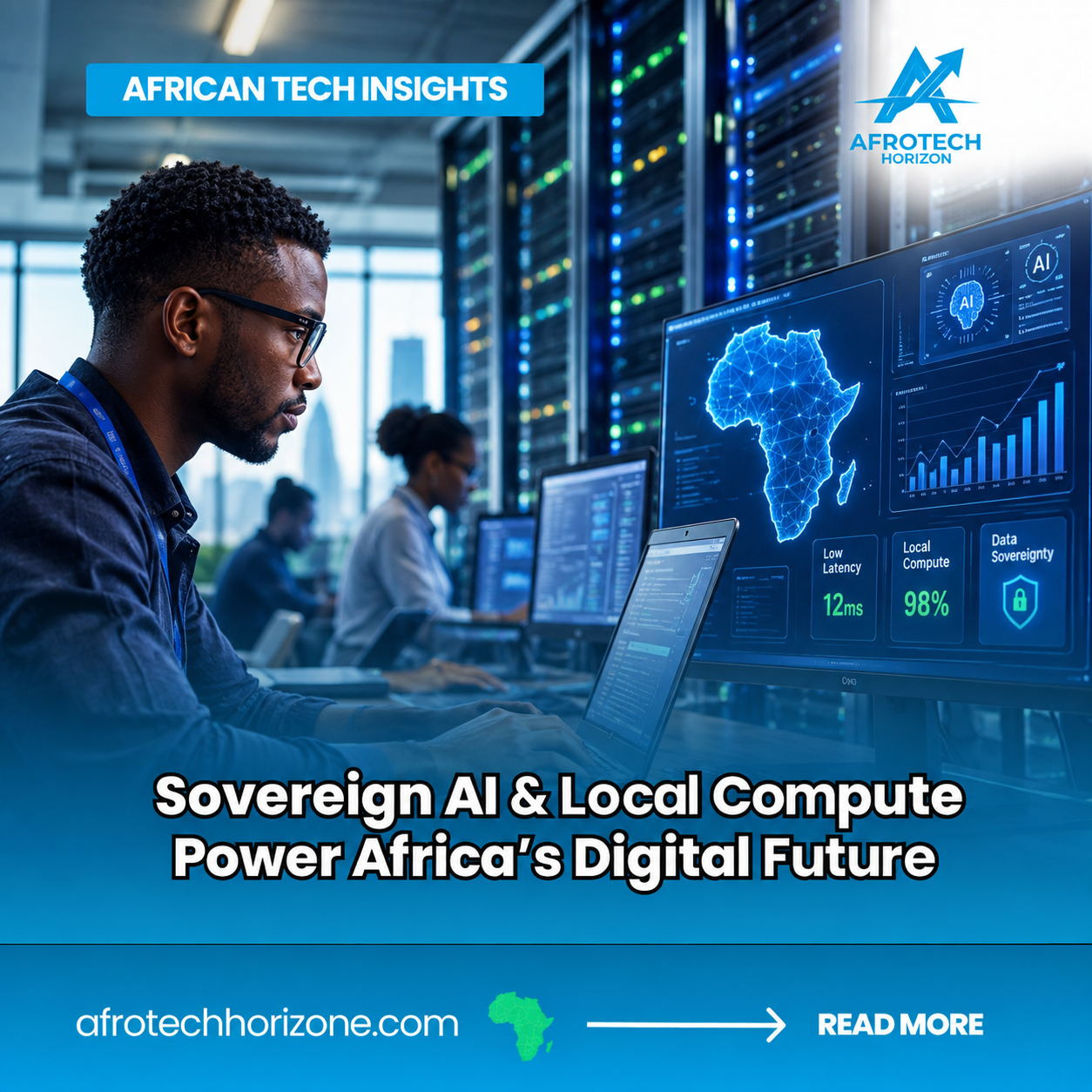
To address this bottleneck, telecommunications giants, private equity investors, and regional governments are accelerating investments in hyperscale data centers, subsea fiber landings, and localized compute capacity.
South Africa, Kenya, Nigeria, and Egypt are leading this charge, establishing high-capacity data parks powered by renewable energy microgrids. Meanwhile, initiatives exploring fabless chip design and local assembly, testing, and packaging (ATMP) facilities—such as emerging semiconductor investments in West Africa—signal a determination to build hardware adapted for tropical climates and power-constrained environments.
Concurrently, policy leaders are establishing sovereign AI frameworks. These legal frameworks require that sensitive public sector records, healthcare data, and financial transactions be processed and stored on servers located within national or regional borders, protecting data privacy and national security.
AI Agents Built for Local Commerce
Sovereign AI is not just about building data centers—it is about training algorithms on native data. Startup labs across West and East Africa are fine-tuning specialized LLMs that natively comprehend languages like Swahili, Hausa, Yoruba, Amharic, and Wolof.
When an AI agent understands how business communication, informal credit agreements, and local trade slang work in practice, customer support automation becomes far more empathetic and efficient. In healthtech, platforms like Nigeria's Eight Medical utilize AI-driven logistics via basic WhatsApp interfaces to route emergency ambulances to nearby open hospital beds within 10 minutes—a life-saving workflow that requires hyper-local geographic data.
The part that is not about server racks
Digital sovereignty is about self-determination. When a continent builds its own compute infrastructure and trains its own AI models, it stops being a passive consumer of foreign technology. It ensures that African engineers, scholars, and entrepreneurs retain control over their digital narrative, intellectual property, and economic future.
Industyr takeaway
The shift toward sovereign compute hubs and local language AI models is creating a defensible enterprise software market immune to foreign exchange shocks.
Source & Further Reading: Punch Newspapers - Tech in Africa: What to Expect in 2026